
Stress‑test tomorrow’s networks today.
Replicate real‑world Network conditions with nanosecond precision, seamless automation, and deep visibility—ensuring your applications, protocols, and devices perform flawlessly under any challenge
EtherExpert-NE

Confidence in Every Connection
Ensure your enterprise, carrier, or cloud services deliver reliable performance worldwide—Packetronix empowers teams to de‑risk deployments, meet SLAs, and accelerate innovation with real‑world WAN validation.

Time and Packet Based Impairment Distributions

Up to 15 Secs of Delay with 1 uSec Increament
User Defined up to 32 Streams/Paths
Key Features
Hardware Based Impairments Emulation
1/10/25/100 Gbps at Line Rate Impairments
Multi-user Web-based UI for ease of use
IPv4 / IPv6 Simultaneous Support
Built-in REST APIs for Test Automation
1/10/25/100 Gbps Network Impairment Emulator
Modern networks must handle a wide spectrum of traffic—from latency‑sensitive voice and video to high‑throughput data center and cloud workloads. To guarantee reliability, performance, and resilience, it’s essential to validate equipment, protocols, and applications under realistic and often adverse conditions before deployment.
The Packetronix Network Impairment Emulator is a high‑performance platform built to replicate real‑world network behaviors in a controlled lab environment. Designed for engineers, testers, and developers, it enables precise analysis and stress‑testing across enterprise, carrier, and cloud infrastructures. With support for multiple line rates (1G/10G/25G/100G), the system scales seamlessly to meet diverse testing needs.
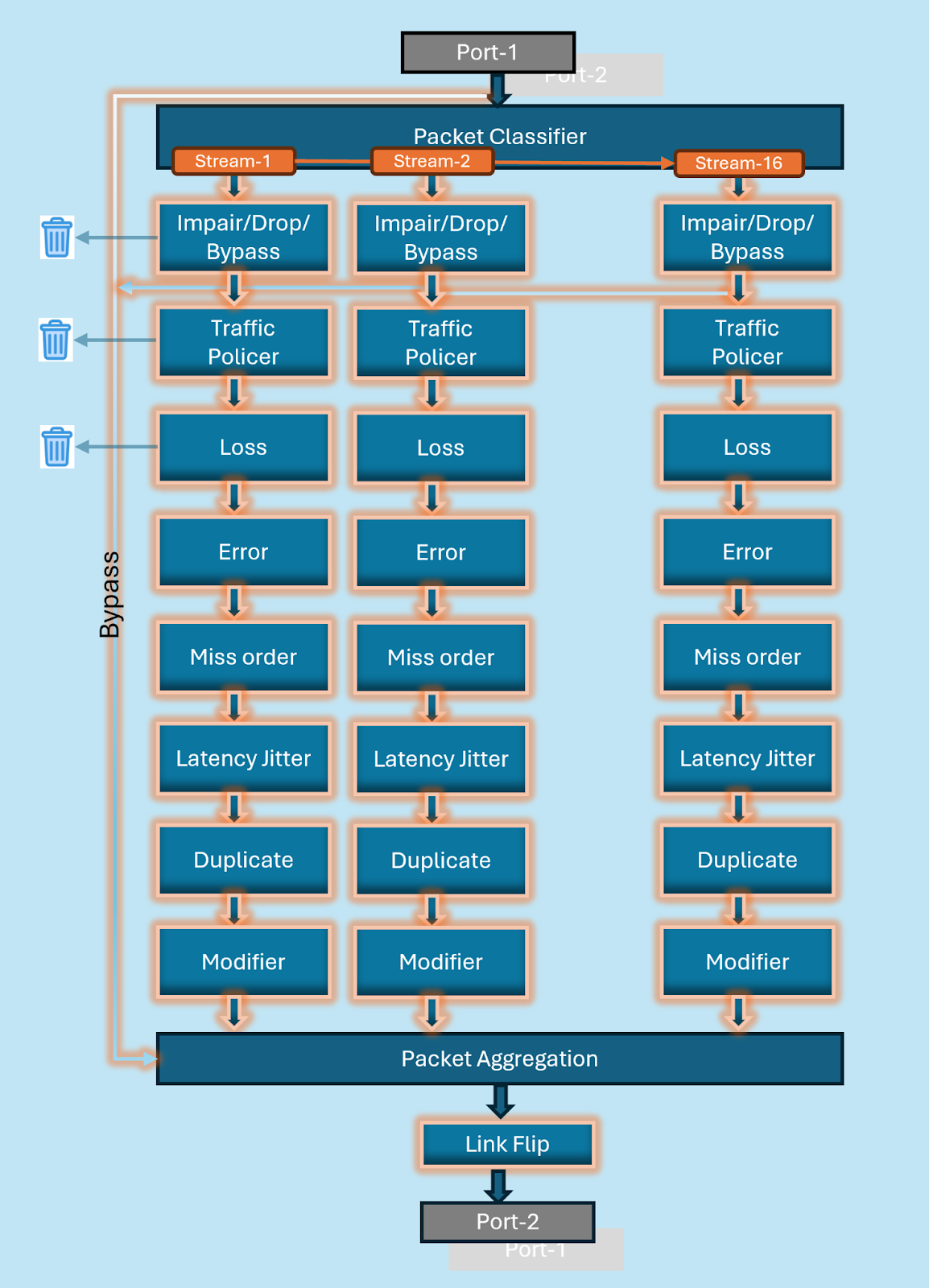
Unlike basic pass‑through devices, Packetronix offers fine‑grained stream identification and filtering, giving users full control over which traffic is impaired, bypassed, or dropped. Each stream can independently run in Impair, Bypass, or Drop mode, with up to 16 paths per port, ensuring flexibility in complex scenarios.
The advanced impairment engine introduces controlled conditions such as bandwidth limits, packet loss, delay, jitter, mis-ordering, duplication, corruption, protocol field modifiers, and link flaps. These capabilities allow teams to replicate challenging WAN environments and validate application resilience. For ultra‑low latency requirements, features like WAN bypass with cut‑through forwarding ensure traffic is handled with minimal delay.
Web‑based user interface: Accessible from anywhere in the world, simplifying setup and operation.
REST APIs: Seamless integration with automated test frameworks for CI/CD pipelines and regression testing.
FPGA‑based hardware: Purpose‑built for nanosecond‑level precision in impairment control, ensuring unmatched accuracy.
Packet capture with nanosecond timestamps: Capture traffic in PCAP format with user‑defined capture paths, enabling deep protocol analysis and forensic validation.
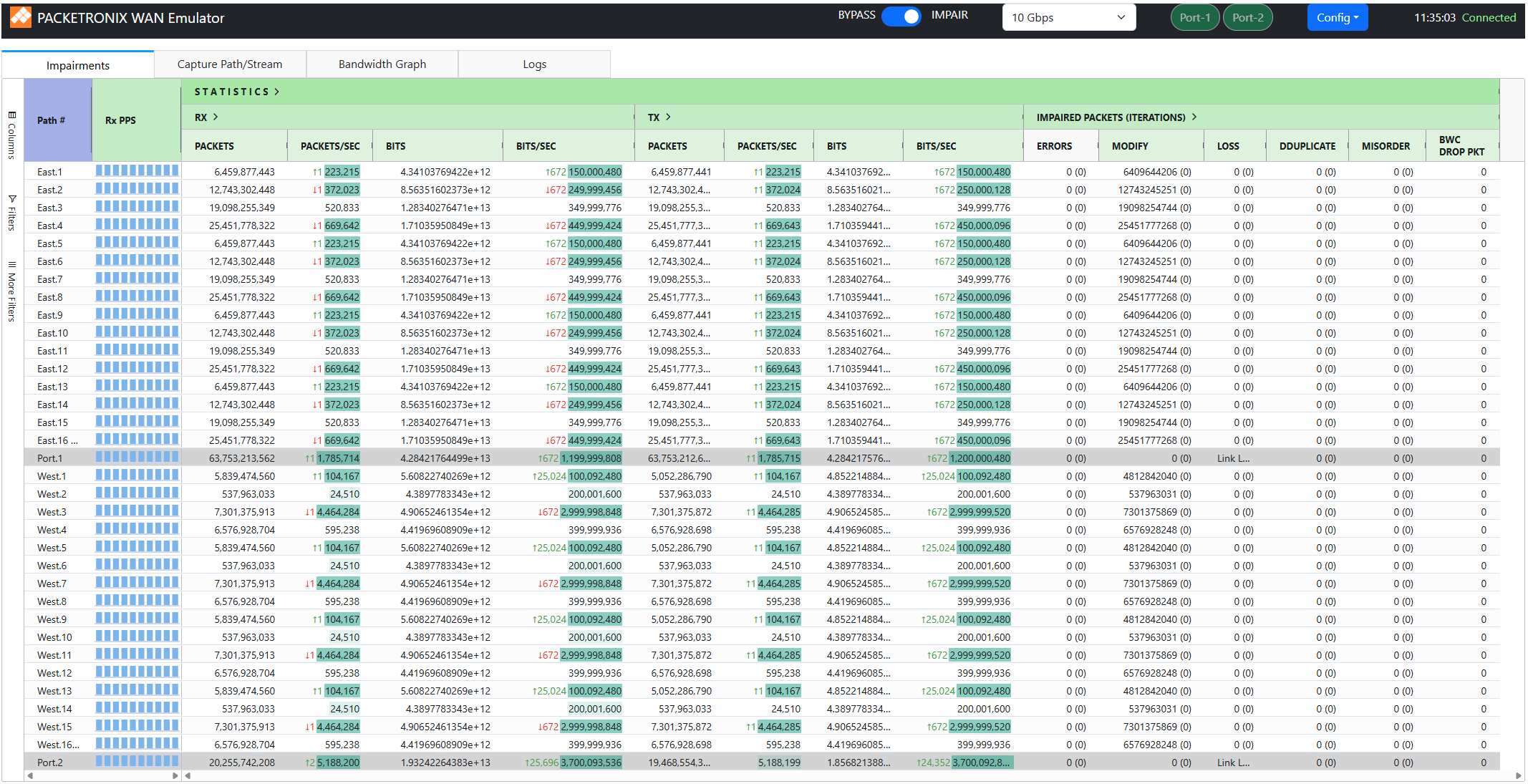
To complete the solution, the emulator delivers real‑time statistics and metrics at both per‑stream and aggregate levels.
-
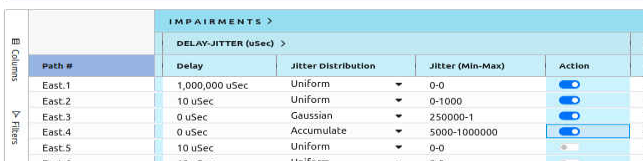
![Table displaying different path options with delay, jitter distribution, jitter range, and activation toggles for network impairment settings.]()
Delay-Jitter
-
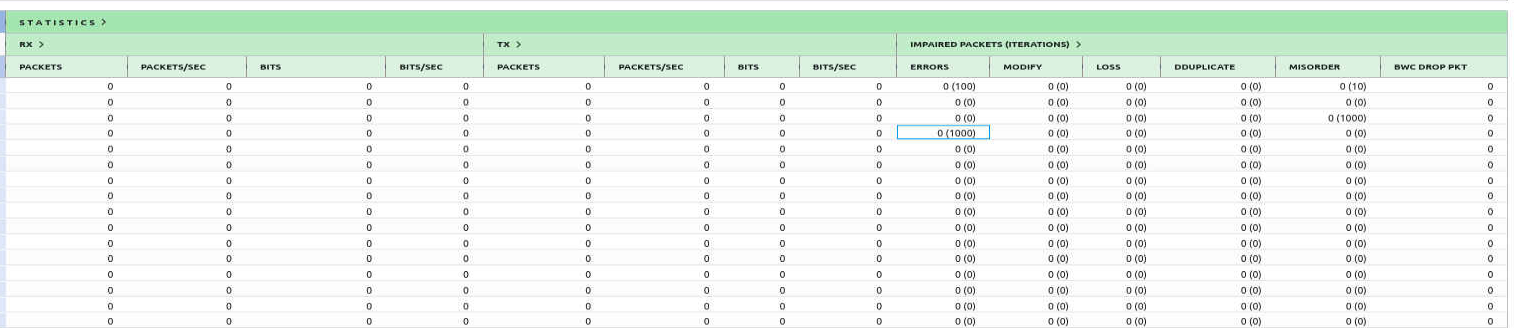
![Loss Impairment]()
Loss Impairment
-
![Stream Stats]()
Stream Stats
-
![Stream Stats]()
Stream Stats

Use Cases
Application & Service Validation
Video conferencing and VoIP testing: Emulate intercontinental links to assess call quality and video performance under high latency or packet loss.
SaaS/cloud application validation: Test responsiveness of applications when users connect from remote offices with varying bandwidth and delay.
Streaming/media services: Evaluate how jitter and throughput fluctuations affect playback quality.
Optimize application behavior in environments with delay, jitter, or reordering.
Emerging Technologies
5G/6G and non-terrestrial networks: Emulate wireless links between smartphones and satellite-based 5G networks to test mobility and call quality.
IoT deployments: Validate sensor data transmission reliability under constrained bandwidth or intermittent connectivity.
Software-defined vehicles and automotive networks: Assess performance of in-vehicle communication systems under varying latency conditions.
QoS and SLA verification: Ensure compliance with service-level agreements (e.g., sub-10ms latency for 5G URLLC applications).
Lab & Pre-Deployment Testing
Reproduce production conditions in the lab: Bring real-world impairments into controlled environments for repeatable, precise testing.
Protocol and traffic profiling: Impair specific application traffic (e.g., video vs. file transfer) to study differentiated impacts.
Impairment replay: Record real impairment patterns and reproduce them with impairments to evaluate robustness..
Benchmark device performance under constrained bandwidth or lossy conditions.
Policy and routing validation: Test how ACLs, firewalls, or routing policies behave under impaired conditions.
Enterprise & Military
Infrastructure resilience: Stress-test enterprise networks with controlled impairments like 5% packet loss or bursty traffic.
Validate network and application resilience against real-world impairments.
Remote office connectivity: Simulate WAN links to test collaboration tools across continents.
Defense and mission-critical networks: Validate soldier and equipment connectivity under battlefield-like impairments.
Disaster recovery planning: Test failover systems under degraded network conditions.
Specifications